
The Agentic Shift: AI Innovations from Adobe Summit 2026
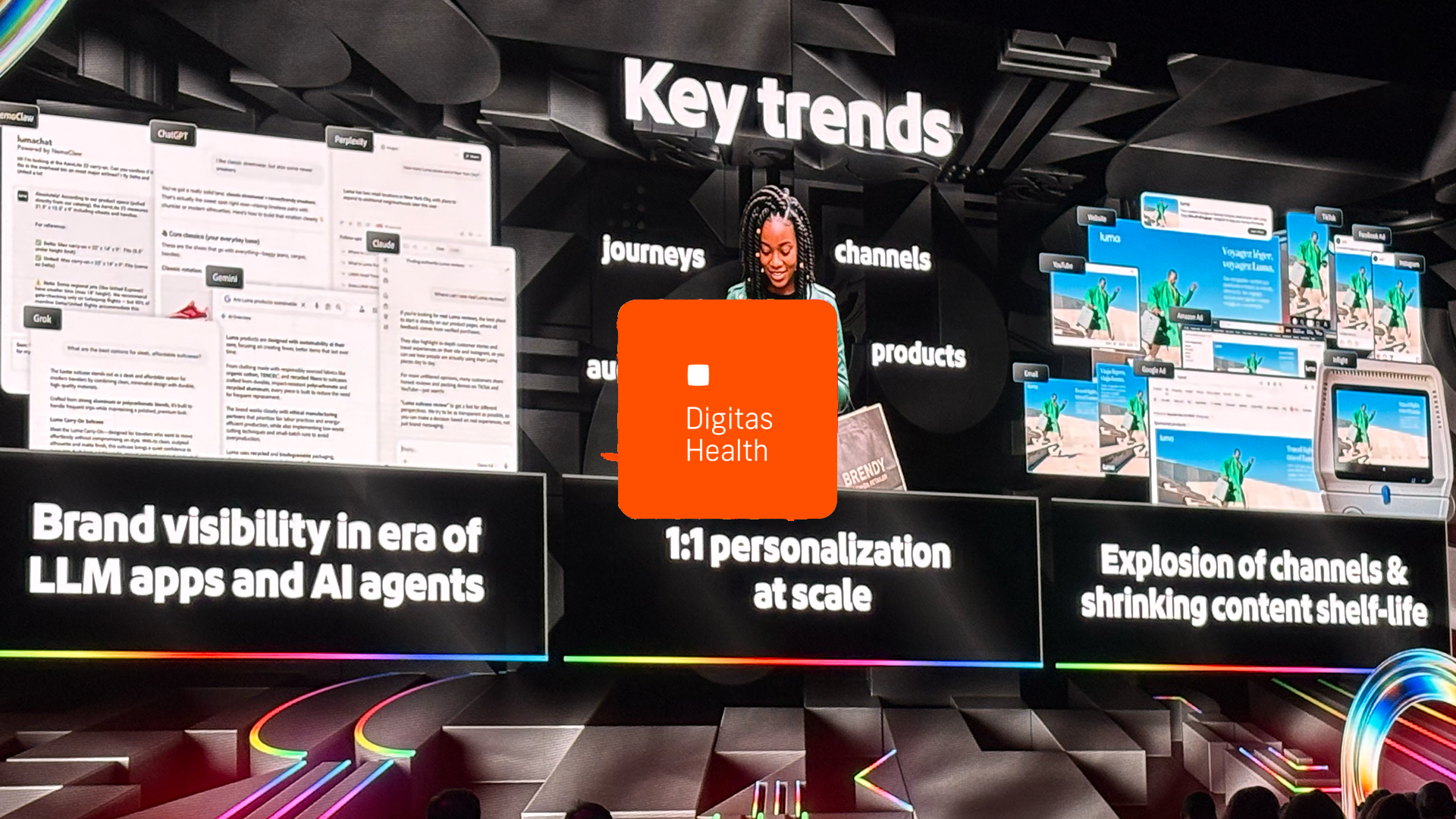
Agentic AI was the central theme across the Adobe ecosystem at Adobe Summit 2026 this year. Being in Vegas always creates a great deal of excitement and extra caffeination given the late nights, but this year’s Summit had a different kind of buzz — driven by the shift toward end-to-end Customer Experience Orchestration (CXO) and Agentic AI solutions grounded in data, content, and customer journeys.
While much of the keynote content focused on retail, media, and B2C use cases, there are real opportunities for pharma brands to leverage Adobe’s agentic capabilities across their data and content operations. For the pharma marketer, these capabilities bridge the gap toward greater content acceleration and personalized digital experiences at scale for both patients and healthcare professionals (HCPs).
Here are some of the most notable takeaways relevant to life sciences from Summit (by no means an exhaustive list):
The Agentic Orchestrator
At the top of the announcement list, Adobe redefined its digital stack with the launch of Adobe CX Enterprise, an end-to-end agentic AI platform built on a composable architecture leveraging Model Context Protocol (MCP) and the Adobe Experience Platform Agent Orchestrator (announced at Summit in March 2025). The platform is organized around three pillars: Brand Visibility, Customer Engagement, and Content Supply Chain. Powered by the Adobe AI Platform, CX Enterprise is designed to orchestrate agents across the Adobe ecosystem to automate and streamline marketing workflows. For pharma marketers, this means unifying fragmented data, content, and patient and HCP journeys into one coordinated system for more seamless orchestration and optimization.
The Agentic Teammate
Sitting within Adobe CX Enterprise, the new CX Enterprise Coworker is powered by the newly announced NVIDIA Agent Toolkit. Coworker is an AI teammate that executes complex, multi-step marketing tasks based on broad business goals. For example, if a pharma marketing team needs to increase enrollment for a patient support program by 5%, Coworker can coordinate across multiple agents to assemble audience segments, creative assets, and performance insights into a comprehensive plan for human approval, potentially streamlining the manual hand-offs between brands, agencies, and MLR teams.
The Agentic Brand Brain
Pharma compliance can no longer rely on static brand playbooks sitting on a network drive. Adobe Brand Intelligence functions as a continuously learning engine that builds a living brand knowledge center. It ingests both documented brand guidelines and the human inputs that constitute institutional memory — annotations, reviewer feedback, and past approval patterns. For pharma brands, the potential is transformative: Brand Intelligence can act as part of the MLR pre-check layer, helping enforce brand policies and approved assets automatically before content reaches MLR teams. By learning from previous regulatory feedback and decisions, the system helps AI agents stay within strict visual and legal guardrails with the potential to reduce the rework cycles that typically accompany new indication launches.
The Agentic Content Supply Chain
The expansion of Adobe GenStudio—specifically the Workflow Optimization Agent in Workfront and the new AI agent for brief creation in GenStudio—addresses the content gap marketers face with a 5x increase in content demand from strategy through activation. For pharma, the challenge is delivering hundreds of compliant content variants tailored to specific consumer or HCP segments without extending timelines by weeks or months due to MLR bottlenecks. These agentic tools help automate tasks and workflows by streamlining batch production and reducing manual process steps. Even modest improvements in cycle times through content review and approval will help pharma brands keep up with rising content demand.
The Agentic Web
The rise of the agentic web introduces a new stakeholder: the AI agent. U.S. retail sites saw a 269% year-over-year increase in AI traffic in March 2026, according to Adobe data. Pharma brands are likely seeing similar increases as patients and HCPs turn to LLMs like ChatGPT and Gemini to research conditions, therapies, and efficacy. The Adobe Brand Visibility solution for the Agentic Web is an expansion of Adobe Experience Manager designed to optimize brand presence across the AI ecosystem and help strengthen GEO (Generative Engine Optimization) and AEO (Answer Engine Optimization) tactics. Coupled with Adobe LLM Optimizer (announced last year), brands can ensure approved content is accurately cited by LLMs, protecting against the risk of inaccurate or outdated information being surfaced to patients and HCPs.
Closing Thoughts
Adobe Summit 2026 made one thing clear: the agentic era isn’t on the horizon—it’s here. For pharma marketers, the opportunity is there to explore. The combination of Adobe Brand Intelligence, agentic content workflows, MCP-governed compliance, and AI-driven brand visibility creates a foundation where pharma brands can move faster within a compliant, governed platform. One thing is certain, AI has moved at an accelerated pace over just the last few months, and I can only imagine what the coming months will bring. That’s a wrap for Adobe Summit 2026, see you next year!